
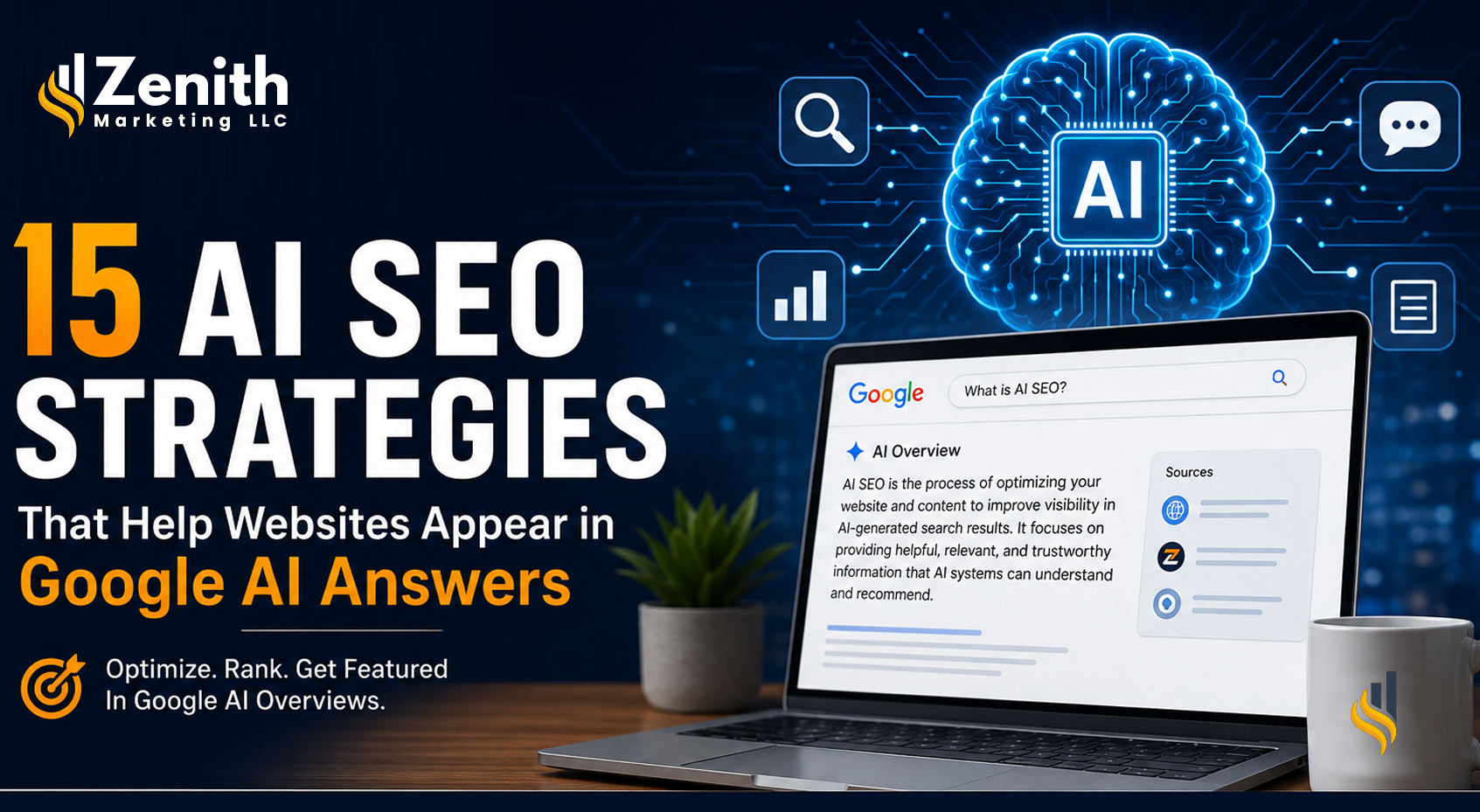
AI SEO Strategies
Search is changing faster than ever. Google’s AI-powered search experiences, including AI Overviews and AI-generated answers, are transforming how users find information online. Instead of simply displaying a list of blue links, Google is increasingly generating direct answers that summarize information from trusted sources.
For businesses, this means traditional SEO alone is no longer enough. Ranking on page one remains important, but appearing inside Google’s AI-generated answers can dramatically increase brand visibility, authority, and qualified traffic.
Companies that adapt early will gain a competitive advantage, while those relying on outdated SEO tactics may see declining visibility over time.
In this guide, we’ll explore 15 proven AI SEO strategies that help websites improve their chances of appearing in Google AI Answers, AI Overviews, and future AI-driven search experiences.
Also Read:
Why Your Google Business Profile Visibility Dropped After the 2026 Google Update
What Are Google AI Answers and AI Overviews?
Google AI Answers are generated responses that appear directly within search results. Instead of forcing users to visit multiple websites, Google summarizes information from trusted sources and presents a comprehensive answer.
AI Overviews typically appear for informational searches, comparison searches, and complex questions where users need more context.
Examples include:
- How does local SEO work?
- What is AI SEO?
- Best marketing strategies for contractors
- How to improve Google rankings
- What are the benefits of CRM automation?
The goal of AI SEO is to optimize your website so Google views your content as trustworthy enough to be referenced in these AI-generated responses.
Why Traditional SEO Alone Is No Longer Enough
Traditional SEO focused heavily on rankings, keywords, and backlinks. While those factors remain important, Google’s AI systems now evaluate content differently.
AI search engines prioritize:
- Topical authority
- Expertise
- Trustworthiness
- Comprehensive answers
- User intent satisfaction
- Content quality
Businesses investing in professional SEO Services are increasingly focusing on AI search optimization alongside traditional search rankings.
How Google AI Chooses Sources for AI Answers
Although Google doesn’t reveal its exact algorithm, several factors consistently influence AI-generated answers.
- Authority of the website
- Quality of content
- Expertise demonstrated
- Backlink profile
- User engagement signals
- Content freshness
- Technical website performance
Understanding these signals helps businesses develop effective AI SEO strategies that improve visibility in AI search experiences.
1. Build Topical Authority Instead of Isolated Pages
One of the biggest mistakes businesses make is creating random blog posts without a broader content strategy.
Google’s AI systems prefer websites that demonstrate expertise across an entire subject area.
For example, a digital marketing website should publish content covering:
- SEO
- Local SEO
- Technical SEO
- Content marketing
- Link building
- AI SEO
- Google Business Profile optimization
Creating topic clusters helps establish authority and increases the likelihood of being referenced in AI-generated answers.
2. Answer Questions Clearly and Directly
AI systems love clear answers.
Each major section of your content should provide concise, direct responses before expanding with detailed explanations.
For example:
What is AI SEO?
AI SEO is the process of optimizing content and websites to improve visibility in AI-generated search results such as Google AI Overviews and AI Answers.
This direct-answer format makes it easier for AI systems to understand and cite your content.
3. Optimize for Conversational Search Queries
Users are increasingly searching using natural language.
Instead of searching:
“AI SEO”
They search:
- How do I rank in Google AI Overviews?
- Why isn’t my website appearing in AI search results?
- What helps websites appear in AI answers?
Creating content around real user questions significantly improves AI search visibility.
4. Develop Comprehensive Content Clusters
Google AI prefers sources that cover topics thoroughly.
A comprehensive AI SEO content cluster may include:
- AI SEO Guide
- Google AI Overview Optimization
- AI Search Ranking Factors
- AI Content Marketing
- Local AI SEO Strategies
- Future of AI Search
Supporting articles strengthen topical authority and help search engines better understand your expertise.
5. Improve EEAT Signals Across Your Website
Google emphasizes Experience, Expertise, Authoritativeness, and Trustworthiness (EEAT).
Strong EEAT signals include:
- Detailed author information
- Case studies
- Customer testimonials
- Industry expertise
- Accurate content
- Regular updates
Businesses serving specialized industries such as Dentists, HVAC Companies, Electrical Contractors, and Restaurants benefit significantly from demonstrating industry-specific expertise.
6. Use Structured Data and Schema Markup
Schema markup helps search engines understand your content more effectively.
Important schema types include:
- Article Schema
- FAQ Schema
- Local Business Schema
- Organization Schema
- Service Schema
Schema does not guarantee inclusion in AI Answers, but it improves content understanding and visibility.
7. Strengthen Internal Linking Architecture
Internal linking remains one of the most underrated AI SEO strategies.
Strong internal links help Google understand content relationships and topical relevance.
For example, this article naturally connects to:
- SEO Services
- Content Marketing Services
- Link Building Services
- Web Design & Development
- CRM & AI Automation
Well-structured internal links improve crawlability, user experience, and topic authority.
8. Publish Original Research and Insights
AI systems often prioritize original information over recycled content.
Businesses can stand out by publishing:
- Case studies
- Industry surveys
- Performance data
- Client success stories
- Trend reports
Original research makes your content more valuable and more likely to be cited by AI systems.
Frequently Asked Questions About AI SEO
What is AI SEO and how is it different from traditional SEO?
AI SEO focuses on optimizing content and websites for AI-powered search experiences such as Google AI Overviews and AI-generated answers. Traditional SEO primarily focuses on ranking web pages in search results, while AI SEO aims to make content easily understandable, trustworthy, and useful enough to be referenced directly by AI systems.
How can my website appear in Google AI Answers?
Websites appear in Google AI Answers by demonstrating expertise, publishing comprehensive content, answering user questions clearly, earning authority backlinks, and maintaining strong technical SEO. Google’s AI systems prioritize trusted sources that provide accurate and valuable information.
Do backlinks still matter for AI search rankings?
Yes. High-quality backlinks remain one of the strongest authority signals for both traditional SEO and AI-driven search. Earning links from reputable websites helps establish trust and increases the likelihood of your content being considered for AI-generated responses.
What types of content perform best in Google AI Overviews?
Content that directly answers questions, provides detailed explanations, includes supporting examples, and demonstrates expertise tends to perform best. Long-form guides, tutorials, case studies, industry insights, and FAQ-rich content are often favored by AI search systems.
Can local businesses rank in Google AI search results?
Absolutely. Local businesses can appear in AI-generated recommendations when they have strong local SEO, optimized Google Business Profiles, quality reviews, location-specific content, and a strong online reputation within their service areas.
Does schema markup help websites appear in AI Answers
Schema markup helps search engines better understand your content and website structure. While schema alone won’t guarantee placement in AI Answers, it can improve content interpretation and increase the chances of being selected as a trusted source.
How long does it take to see results from AI SEO strategies?
AI SEO is a long-term strategy similar to traditional SEO. Depending on your industry, competition, and website authority, noticeable improvements may take several weeks to several months. Consistency, content quality, and authority building are key to long-term success.
Final Thoughts: AI SEO Is the Future of Search Visibility
The way people search online is changing rapidly, and Google’s AI-powered search experiences are leading that transformation. Businesses that continue relying solely on traditional SEO tactics may find it increasingly difficult to maintain visibility as AI-generated answers become more prominent in search results.
The good news is that the fundamentals of strong SEO still matter. High-quality content, topical authority, trusted backlinks, exceptional user experience, and clear expertise remain essential ranking factors. However, AI SEO requires taking those fundamentals further by creating comprehensive content that directly answers user questions and demonstrates real-world expertise.
Whether you’re a local business, contractor, healthcare provider, law firm, or eCommerce brand, implementing these AI SEO strategies can help position your website as a trusted source that Google can confidently reference in AI Answers and AI Overviews.
The businesses that invest in AI search optimization today will be the ones dominating search visibility tomorrow. By focusing on authority, relevance, user intent, and helpful content, you can future-proof your online presence and stay ahead of competitors in the evolving AI search landscape.
Need help improving your AI search visibility? Explore our SEO Services and discover how Zenith Marketing Pros helps businesses build long-term authority, increase organic traffic, and improve rankings across both traditional and AI-powered search results.